
Diving into the Deep End of Water Coil Construction and Performance
What actually happens when you press the “up” button on the thermostat? What makes the air “hot”? Moving heat in and out of buildings is more complex than simply heating and cooling the outdoor air. While outdoor air is typically preconditioned before becoming primary system air, there is often a need for further cooling or reheating for thermal comfort purposes.
Thermodynamically, heat can be moved through a building more efficiently using water than by using air. In fact, water carries over 3,000 times more heat than air does per unit volume (comparing the density and heat capacity of water versus air at standard conditions, water holds 62.4 Btu/ft3-F and air holds 0.018 Btu/ft3-F). For this reason, we often move heat around buildings through water pipes, then exchange that heat to the air system using water coils.
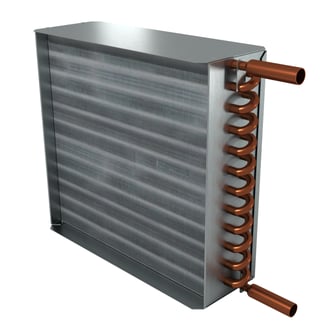 |
| Price’s specialized low water temperature coil |
What Does a Water Coil Do?
A water coil is a form of heat exchanger that transfers heat from a water pipe to an airstream. Hot or cold water flows through the water coil and changes the temperature of many thin aluminum fins. The air traveling through the duct flows through the fins and exchanges heat with them, transferring the heat from the water to the air.
In heating, the entering water temperature (EWT) traditionally ranges from 140°F to 180°F, though it is not uncommon to see an EWT as low as 90°F to 120°F in high-efficiency boilers and other heating systems. In cooling, the EWT is often 42°F to 48°F, which is cool enough to promote condensation (latent cooling) and dry out the airstream, necessitating a drain pan. Some cooling coils utilize a warmer EWT of 56°F–58°F, above the dew point of the entering air. This results in sensible cooling only and removes the requirement of a condensate management system.
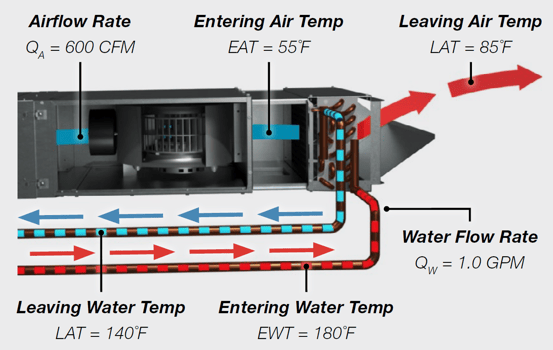 |
| A traditional heating application using a water coil within a fan coil |
What Is a Water Coil Made Of?
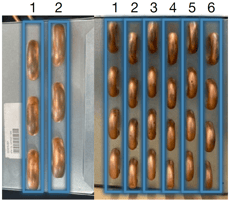
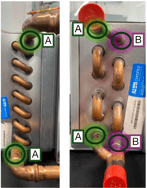
A water coil includes several components, not limited to the steel casing, aluminum fins and copper pipes. The arrangement of the copper piping differs based on the application and required heat transfer. The rows of the coil refer to the number of layers of copper piping in the direction of airflow. More rows result in more contact among the water, air and water coil assembly, increasing the total heat exchange. The circuits refer to the number of unique paths that the piping splits into before entering the coil. The number of circuits are sized to manage the velocity of the water through the pipes.
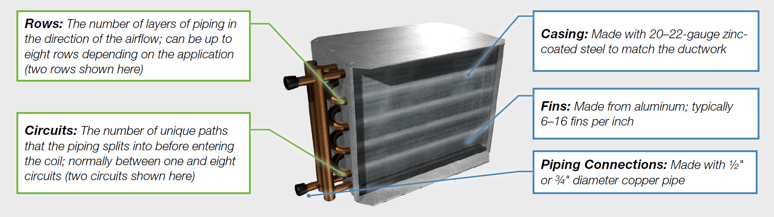 |
| The typical features of a Price water coil used in air distribution applications (note that steam and refrigerant coils may have different constructions) |
How Do You Quantify Water Coil Performance?
The goal of a water coil is to transfer heat (measured in British thermal units per hour, or BTUH) into or out of the air. This can be quickly calculated by measuring the water flow rate (gallons per minute, or GPM) and the difference in entering and leaving water temperatures (degrees Fahrenheit). The heat lost by the water is roughly equal to the heat gained by the air.
Additionally, water coils inherently create some resistance to the flow of water and air in their systems. Depending on the coil’s construction and water flow rate, there will be a water pressure head loss across the coil (feet water gauge, or ft.w.g.), requiring more pump energy to move water through the coil. Water coils also create resistance to the airflow, which is measured as air pressure drop (inches water gauge, or in.w.g).
A properly sized water coil will maximize heat transfer and minimize pressure losses of the air and water pushed through it. It’s important to remember that the rate of heat transfer between air and water is governed by the construction of the water coil itself. This means that while all performance is possible in theory, each unique coil will have its own limited performance range.
Heat Transfer Calculations
| qwater = qair | |
| qwater = 500 * Qwater * (EWT – LWT) q = Heat transfer from water to air (BTUH) Q = Flow rate of water (GPM) EWT = Water temperature entering coil (˚F) LWT = Water temperature leaving coil (˚F) |
qair = 1.08 * Qair * (LAT – EAT) q = Heat transfer from air to water (BTUH) Q = Flow rate of air (CFM) EAT = Air temperature entering coil (˚F) LAT = Air temperature leaving coil (˚F) |
| Heat transfer between air and water is governed by the construction of the water coil: | |
| q = U * A * LMTD | |
| U = Heat transfer coefficient, including for materials, fouling and convection (Btu/ft2-F) A = Effective surface area of the coil (ft2) LMTD = Average difference between water and air across the whole coil (˚F) |
|
| Equations assume standard air and water conditions: | |
| Water: ρ = 62.4 lbm/ft3, cρ =1.0 Btu/lbm-°F Air: ρ = 0.075 lbm/ft3, cρ = 0.24 Btu/lbm-°F |
|
While this post explores water coil styles manufactured by Price, there are other styles of hydronic heating and cooling in the industry. For a deeper dive into water coil construction, including discussion on glycol, tubing arrangements and controls, see the 2024 ASHRAE Handbook – HVAC Systems and Equipment.
How Does the Coil Construction Change Performance?
That’s an excellent question, and there is no simple answer. Let’s break it down by the following design variables:
Fins per Inch (FPI)
|
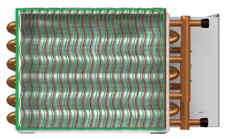
Typically 6–16 FPI. As FPI increases:
|
 |
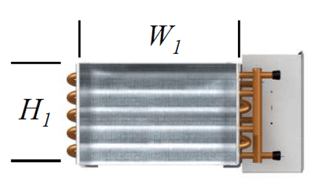
Coil Face Area
|
Size varies based on equipment; increasing
|
 |
Rows
|
Between one and eight rows depending on
|
 |
Circuits
|
Between one and four circuits depending on the product (one and two circuits shown here). As the number of circuits increases:
|
 |
Where Do You Find Water Coils in Price Products?
In quite a few places, actually! While water coils can be installed as stand-alone heat exchangers in ducts, they are often and readily integrated into air distribution equipment. Our recently opened Progress plant in Atlanta, GA – named both aspirationally and eponymously for its Progress Road street address – is dedicated to the manufacturing of our own water coil units. Many types of air distribution equipment use water coils, including fan and blower coils, terminal units and chilled beams.
Did this post whet your appetite for all things water coils? Reach out to our team at fancoils@priceindustries.com to learn more.
 |
Ryan Johnson is Manager of Engineering Programs for Price's Innovation and Learning team. He is based out of Price's facility in Suwanee, GA. |