Using DV Systems for High Heat Gain Applications
Displacement ventilation (DV) systems are revolutionizing how large spaces are cooled and ventilated. Although mostly known for their ability to provide exceptional indoor air quality, DV systems can also reduce total airflow requirements in certain applications.
DV System Fundamentals
DV systems supply low-velocity, cool air (63°F–68°F) directly to the occupied zone, creating a vertical temperature gradient and conditioning only where people are present. DV is well suited for tall spaces and can provide better indoor air quality than a comparable overhead mixing system.
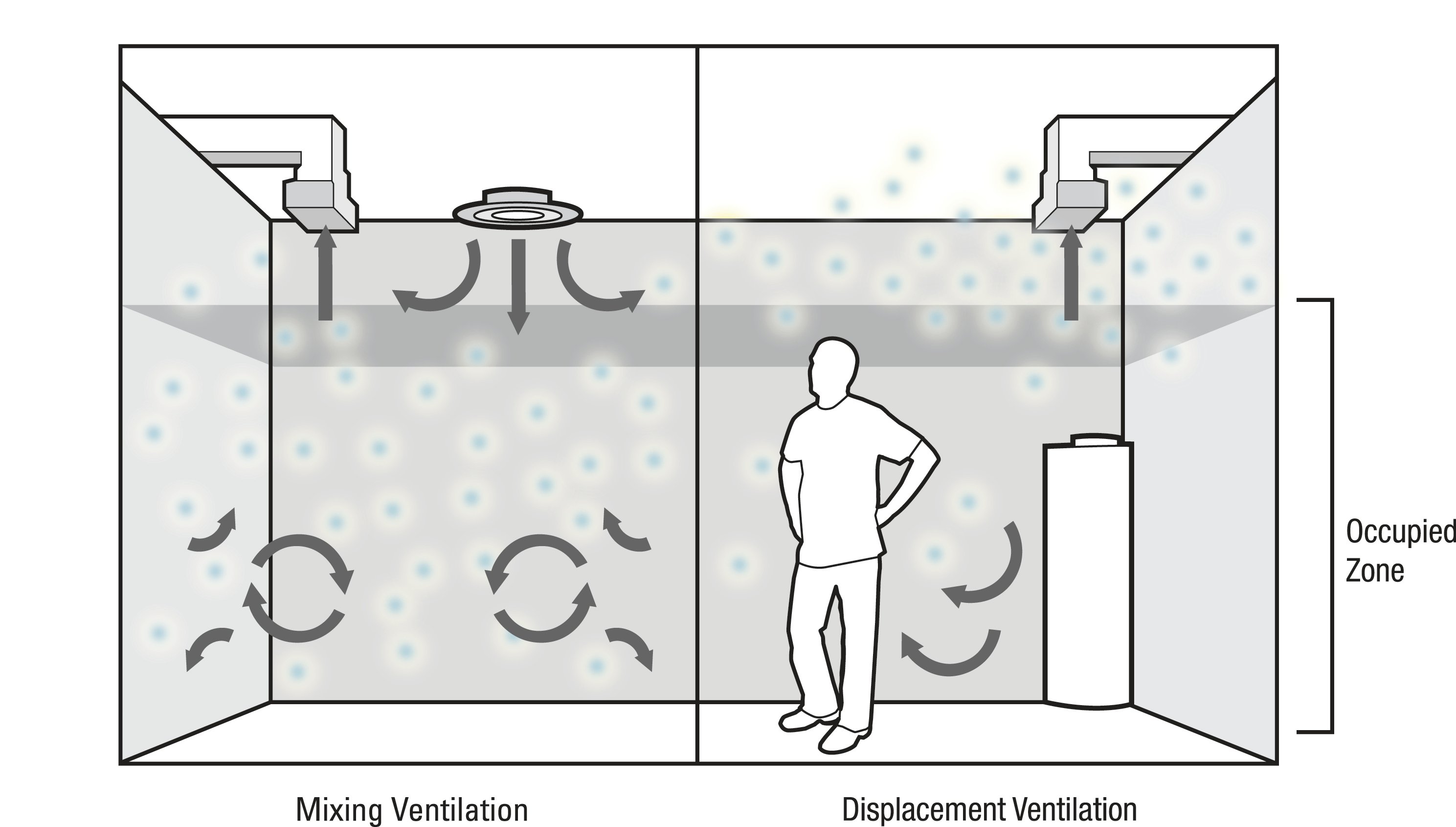 |
| DV systems deliver air directly to the occupied zone |
Thermal Comfort Criteria
Thermal comfort, as defined in ASHRAE Standard 55-2023, Thermal Environmental Conditions for Human Occupancy, is “a condition of mind that expresses satisfaction with the thermal environment.” The standard also provides a method to evaluate it, which is based on six variables: metabolic rate, clothing, dry-bulb air temperature, mean radiant temperature, air speed and humidity.
These six variables are distilled into a single measure of whole-body comfort called the predicted mean vote (PMV), which serves as a subjective comfort evaluation based on a seven-point thermal sensation scale. Local discomfort metrics also apply under specific conditions (such as low clothing level and low metabolic activity) and include radiant temperature asymmetry, ankle draft and the vertical air temperature gradient.
Design Challenges for High Cooling Loads
DV was originally intended for low-to-moderate heat gain applications, with heat gains of 40 BTUH per square foot or less. The maximum cooling load a DV system can handle is constrained by the amount of space required for the DV diffusers as well as thermal comfort considerations.
For a given cooling load, assuming the set-point temperature can be met at thermostat height (usually around 43 inches) and that there is enough wall space to accommodate the diffusers, several comfort issues may occur if the heat gain is very high:
- Ankle draft due to the sheer amount of air volume required to condition the space
- High vertical air temperature gradient due to high heat gain
- High mean radiant temperature (and PMV) if most of the heat gain is solar
CFD Modeling for Air Distribution Systems
Computational fluid dynamics (CFD) is a design tool that can be used to assess how well an HVAC system operates before anything is built. It shows a detailed 3D map of airflow patterns, temperature, air quality and thermal comfort in any indoor space. Thoroughly vetted and lab validated for DV (and other systems), CFD can be used to assess how large of a cooling load a proposed DV system can handle for a given application.
Case Studies
The following case studies are real projects where CFD was used to design a DV system for applications with high cooling loads (greater than 40 BTUH per square foot).
Food Court (Washington, DC)
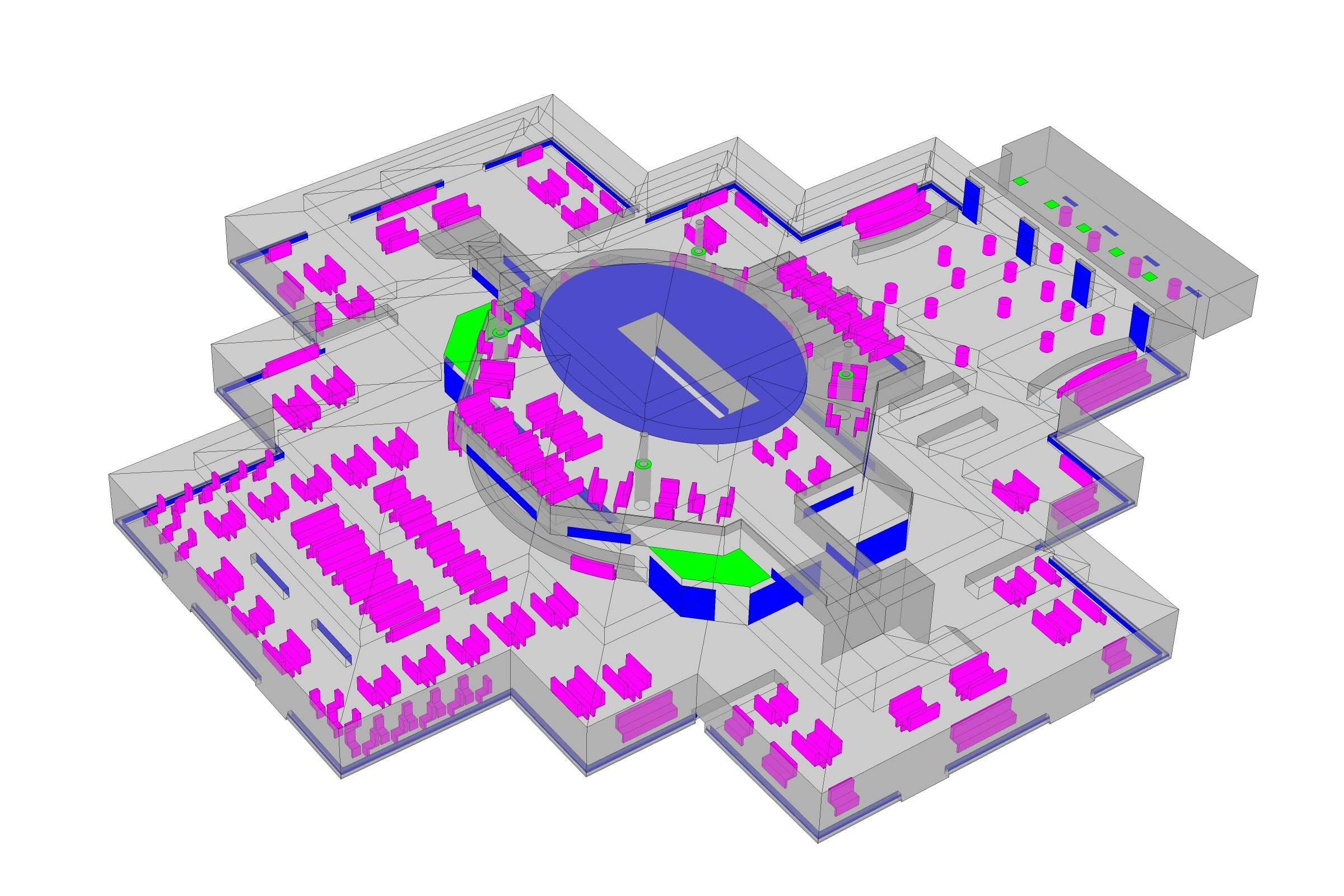
The first example is a two-level food court with a glass roof conditioned by low-level Displacement Flow Recessed Diffusers (DFR) and ceiling-mounted Displacement Flow Ceiling Diffusers (DFC). More than three-quarters of the cooling load is from solar heat gain with the rest coming from occupants.
- Size: 16,000 square feet, 40-foot ceiling
- Supply air volume: 105,000 cfm
- Total heat gain: 2,635,000 BTUH
 |
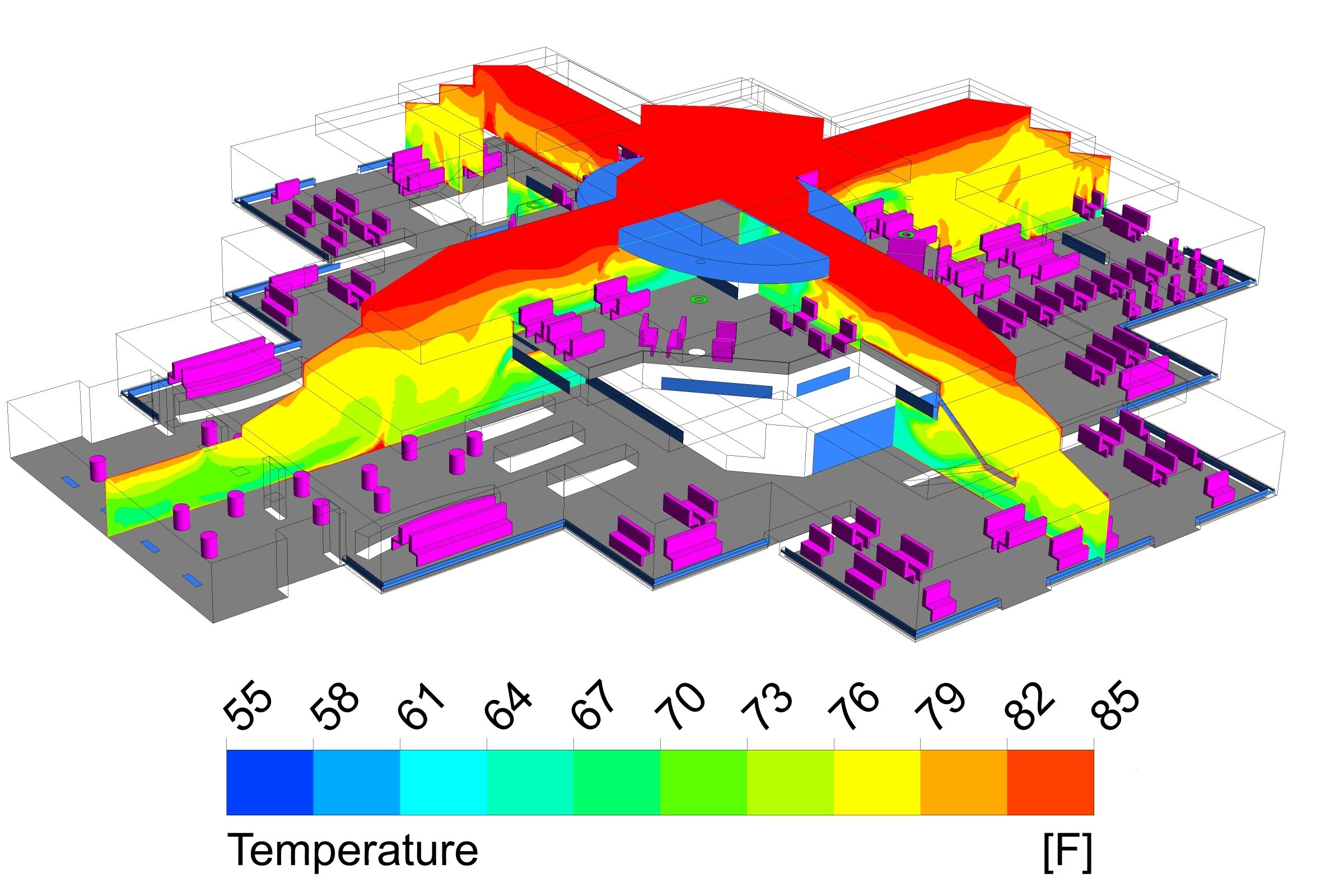 |
| Food court layout (left), showing Price’s DFR low-level supply diffusers in blue and return grilles in green, with the temperature plot (right) | |
The results for the optimized design demonstrate that the occupied zone’s PMV metric, as noted in the table near the end of this post, is within the neutral (compliance) range and that the vertical temperature gradient (ΔThf) is within ASHRAE Standard 55 requirements. Much higher temperatures are evident near the roof, as expected, and are outside of the occupied zone. The ventilation effectiveness is above that of a mixing system on both levels, with lower values on the mezzanine since ceiling-mounted diffusers were used there.
Mosque (Doha, Qatar)
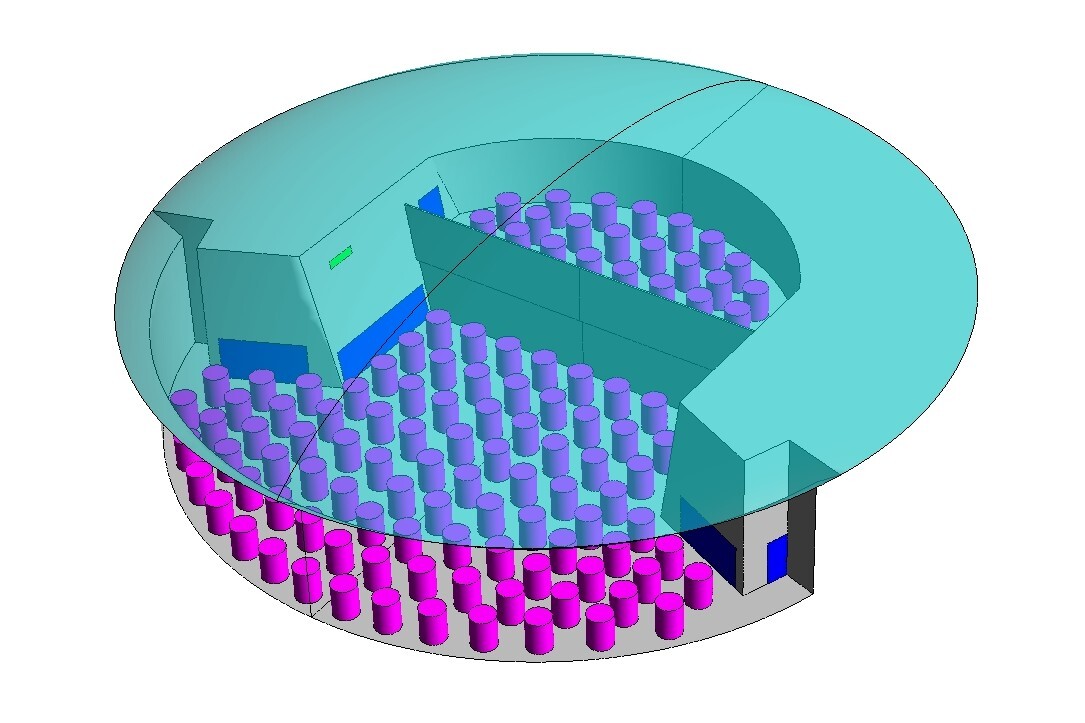
The second example is a mosque with two levels and a dome-shaped glass roof. The space is conditioned with wall-mounted DFR displacement diffusers on both levels, and three-quarters of the cooling load is from solar heat gain.
- Size: 8,000 square feet, 43-foot ceiling
- Supply air volume: 24,410 cfm
- Total heat gain: 836,527 BTUH
 |
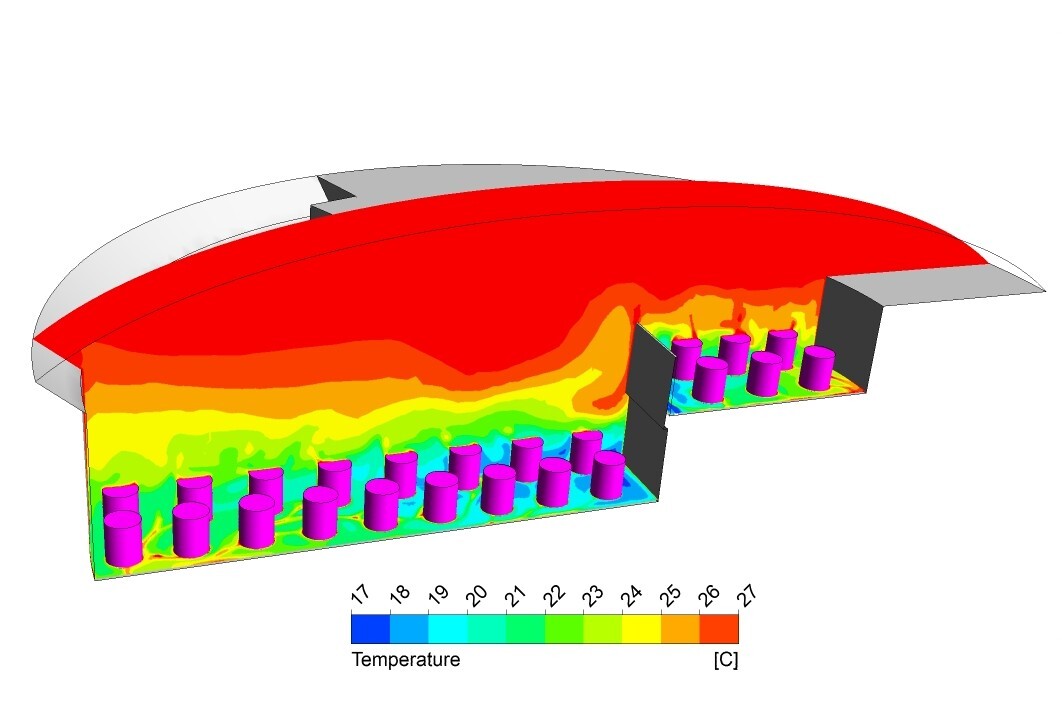 |
| Mosque layout (left), showing DFR low-level supply diffusers in blue and return grilles in green, with the temperature plot (right) | |
The results show significant thermal stratification above the second level, although the vertical temperature gradient in the occupied zone is within ASHRAE Standard 55 compliance on both the main and upper levels. The PMV is within the comfort range on both levels as well, and the ventilation effectiveness is significantly higher for DV systems than what is stipulated in ASHRAE Standard 62.1-2025, Ventilation and Acceptable Indoor Air Quality.
Chip Lab (Guadalajara, Mexico)
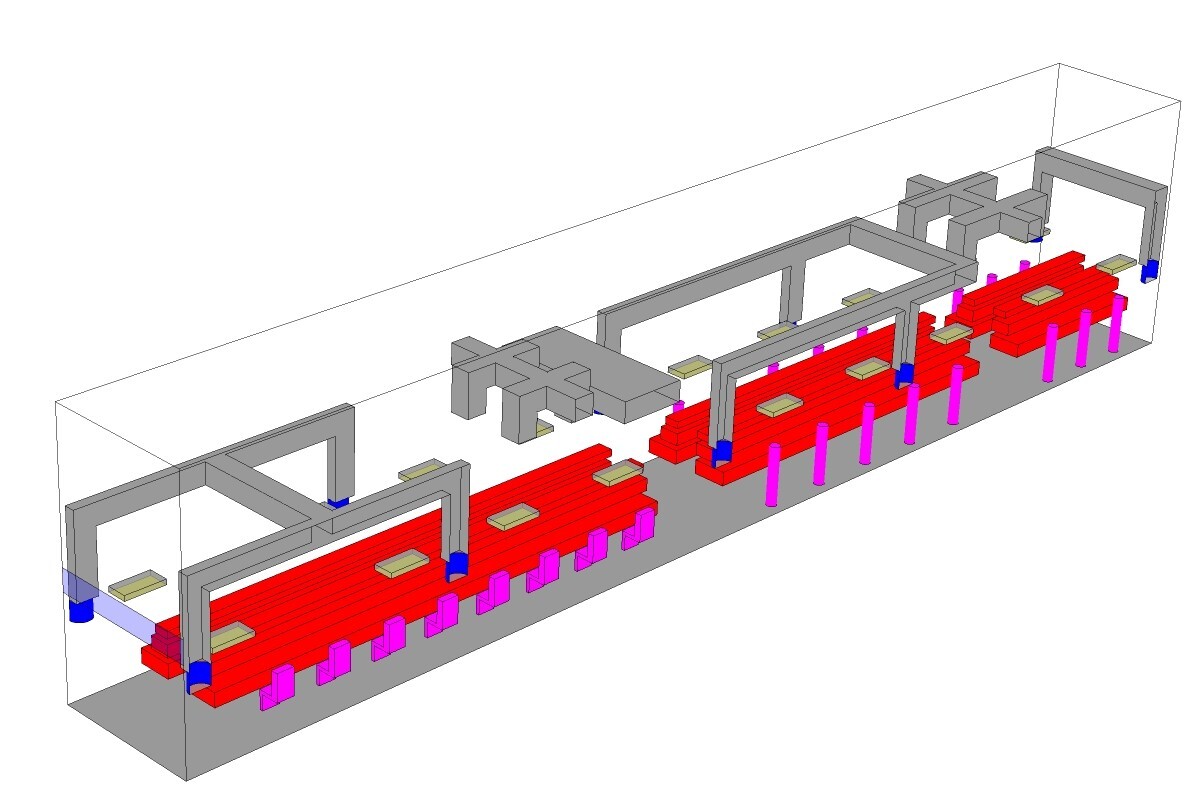
The chip lab is an interior space with a ceiling-mounted DV system and is distinct from the previous two examples because most (98%) of its cooling load is from the equipment. This space has the highest heat gain per square foot out of all three examples.
- Size: 1,800 square feet, 25-foot ceiling
- Supply air volume: 16,413 cfm
- Total heat gain: 448,540 BTUH
 |
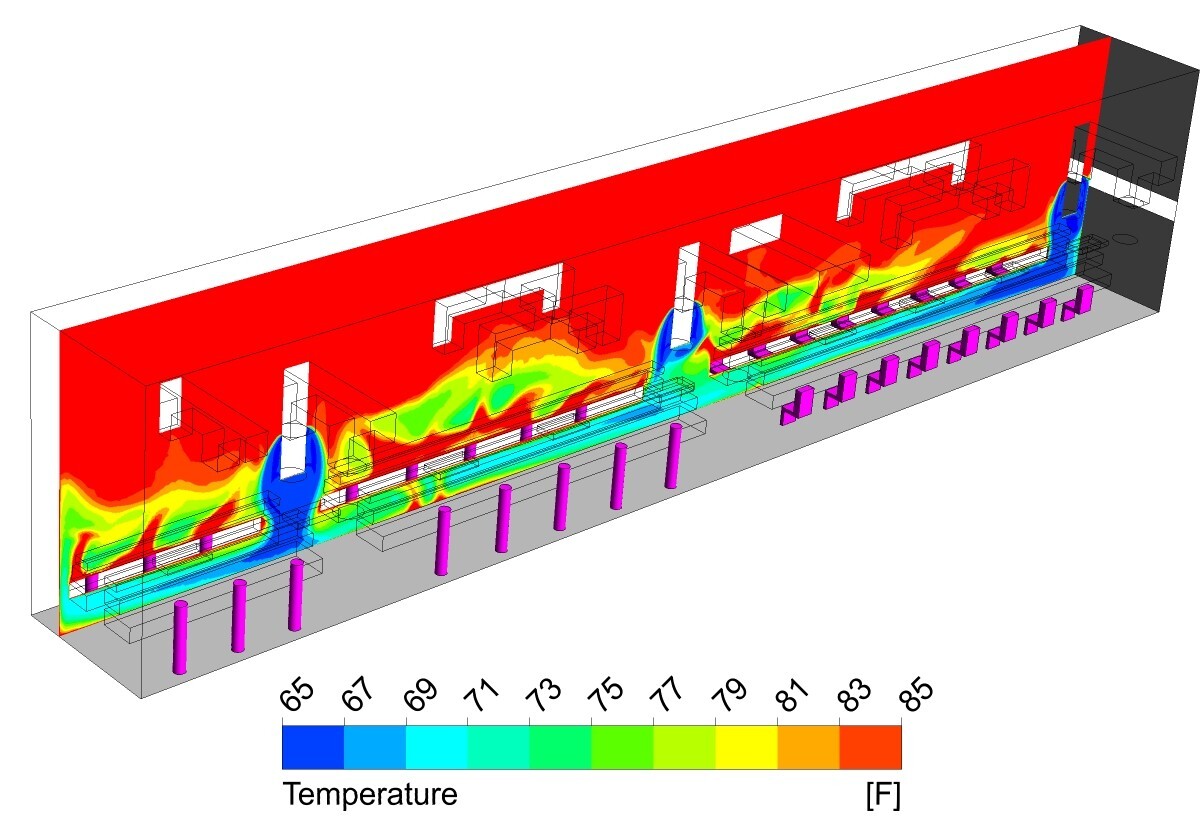 |
| Chip lab layout with DR360 high-level supply diffusers in blue, with the temperature plot (right) | |
For this space, the results show significant thermal stratification with temperatures in the 85°F–90°F range above the occupied zone. Within the occupied zone, the vertical temperature gradient is within ASHRAE Standard 55 guidelines, and the PMV score is almost perfectly neutral. The ventilation effectiveness in the space is also significantly higher than stipulated in ASHRAE Standard 62.1 for a DV system in a space with a high ceiling.
Comparative Analysis
Since a simulation with an equivalent mixing system was not carried out for any of the examples, a hand calculation assuming a perfectly mixed space was substituted to determine the air volume that would be required by a comparable overhead mixing system. In all three examples, the DV system was shown to require anywhere from 13% to 35% less air volume to condition the same load and create comfortable conditions in the spaces despite the high cooling loads.

The case studies show that a carefully designed DV system can achieve thermal comfort for cooling loads greater than 40 BTUH per square foot. Air volume requirements are lower than those of an equivalent mixing system at high cooling loads, but design complexity increases. Diffuser sizing and placement are critical for success, and CFD modeling is essential for ensuring the design works as intended.
For more information about high heat load designs using displacement ventilation, reach out to the Price Sustainable Systems team at sustainable@priceindustries.com.
 |
Chris Burroughs is Product Manager for the Sustainable Systems team at Price. He is based out of Price’s Crestridge facility in Suwanee, GA. Click here to connect with him on LinkedIn. |
|
Mike Koupriyanov is Manager of the Price Predict team. He is based out of Price’s headquarters in Winnipeg, MB. Click here to connect with him on LinkedIn. |